Too Spicy, Too Crunchy, Too Weird: Real Strategies for Getting American-Raised Kids to Fall in Love with Indian Snacks
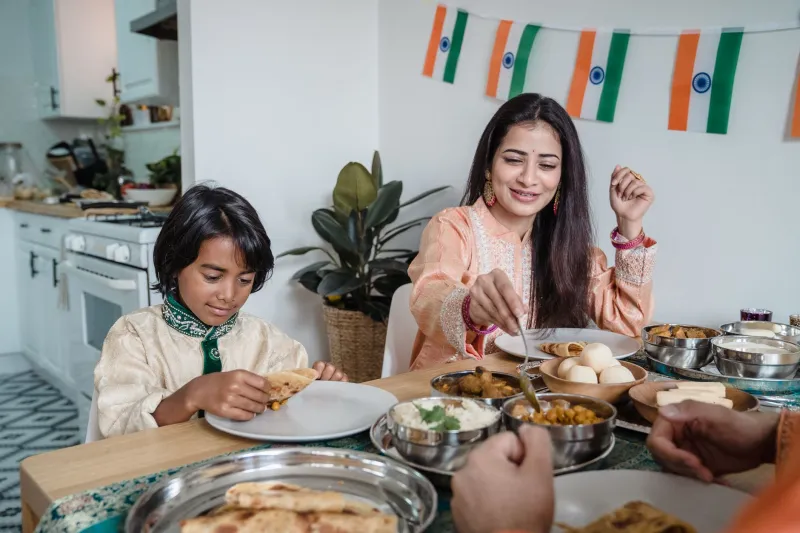
Let's be honest about the scene. You've just received a box from your parents back home — or maybe you ordered a fresh batch online — and you're practically vibrating with excitement. You open the tin, the smell hits you, and for a second you're eleven years old again in your grandmother's kitchen. Then your seven-year-old walks in, sniffs the air, and announces that it "smells weird."
Every Indian immigrant parent with American-raised kids has a version of this story. The rejection isn't personal, and it isn't permanent. But it is real, and navigating it takes more than just insisting they try one bite.
Why the Resistance Happens
Before getting into solutions, it helps to understand what's actually going on. American children grow up in a snack ecosystem dominated by mild, uniform flavors and specific textures — the smooth, the salty, the sweet. Goldfish crackers. String cheese. Applesauce pouches. The flavor profiles are predictable, and predictability is comforting when you're small.
Traditional Indian snacks often do the opposite. They layer flavors — sour and spicy and savory all at once. They have textures that snap, crumble, or dissolve in unexpected ways. For a child with any sensory sensitivity, that unpredictability can feel like a lot.
Add to that the social dimension. If your kid opens their lunchbox at school and pulls out something that looks and smells different from what everyone else has, that can feel isolating — especially in middle school, where being "different" carries real social weight.
None of this means you give up. It means you strategize.
Start with the Gateway Snacks
Not all traditional snacks are equally challenging for uninitiated palates. Some are genuinely approachable for kids who've grown up on American flavors, and these are your starting point.
Roasted makhana (fox nuts) are an almost universal win. Light, airy, mildly salted — they feel like popcorn's more interesting cousin. Butter and mild spice versions are especially easy sells. Most kids who try them keep eating them without much persuasion.
Baked or lightly spiced mathri can work as a cracker substitute. Pair it with cream cheese or hummus and you've bridged the familiar and the new in one snack.
Puffed rice mixes with low heat — versions of murmura that skip the green chili and go easy on the chaat masala — give kids the crunch and the novelty without the sensory overload.
The goal at this stage isn't authenticity. It's the first yes. Once a child has a positive association with an Indian snack, the door is open.
Work the Context, Not Just the Food
Kids are intensely context-dependent eaters. The same food that gets rejected on a Tuesday afternoon can become beloved when it's part of the right moment.
Festival settings work surprisingly well. When chakli or ladoo appears specifically during Diwali or Holi — surrounded by lights, music, and the general excitement of celebration — kids absorb the cultural meaning along with the flavor. The snack becomes part of something bigger than itself.
Cooking together is another powerful lever. Let a child help roll the dough for chakli or mix the spices for namkeen, and suddenly they have ownership over what they made. They're far more likely to try it — and like it — when they helped create it.
Some parents have had luck with the "Nani's secret recipe" framing. Heritage and story give food weight. "This is what your grandmother made every Diwali" lands differently than "eat this, it's good for you."
The School Lunch Question
This one deserves its own conversation, because it's where a lot of the real anxiety lives for both parents and kids.
The honest answer is that school lunch is not the right place to introduce a new Indian snack to an already self-conscious child. The social stakes are too high, the time is too short, and the audience is too unpredictable.
Instead, pack the familiar at school. Save the exploration for home, where failure is private and there's no audience. As kids build confidence with Indian snacks in low-pressure settings, some of them will eventually choose to bring those snacks to school themselves — and that choice, made independently, is worth more than any amount of parental nudging.
When they do bring something to school and a friend gets curious? That's a win you couldn't have scripted.
The Gen-Z Cool Factor Is Real
Here's something that has genuinely shifted in the last few years: Indian food has cultural cachet with younger American audiences in a way it simply didn't before. Chaat, biriyani, and Indian street food are all over TikTok and food media. Indian flavors are showing up in chips, popcorn, and energy bars at mainstream retailers.
For older kids and teenagers, this matters. A snack that connects to something they've seen on social media, or that their non-Indian friends are actually curious about, has a very different social valence than something that just feels like "immigrant parent food."
If your teenager is skeptical of your family's traditional snacks, show them the food content. Let them discover that tamarind and chaat masala are having a moment. Sometimes the path back to heritage runs through pop culture.
Patience Is the Actual Ingredient
Research on children's food acceptance consistently shows that repeated, low-pressure exposure works better than any single dramatic introduction. A child who rejects murukku at six might come around at nine, and actively seek it out at fourteen.
Keep the snacks in the house. Keep the tin on the counter. Keep offering without pressure. Let your own obvious enjoyment do some of the selling.
The goal isn't to force an identity onto your kids — it's to make sure the option is always there, familiar and accessible, so that when they're ready to reach for it, they know exactly what it tastes like.
And when the day comes that your teenager raids your Indian snack stash before you get to it? You'll know the work paid off.