One Handful at a Time: How Indian Professionals Are Quietly Changing What America Snacks On
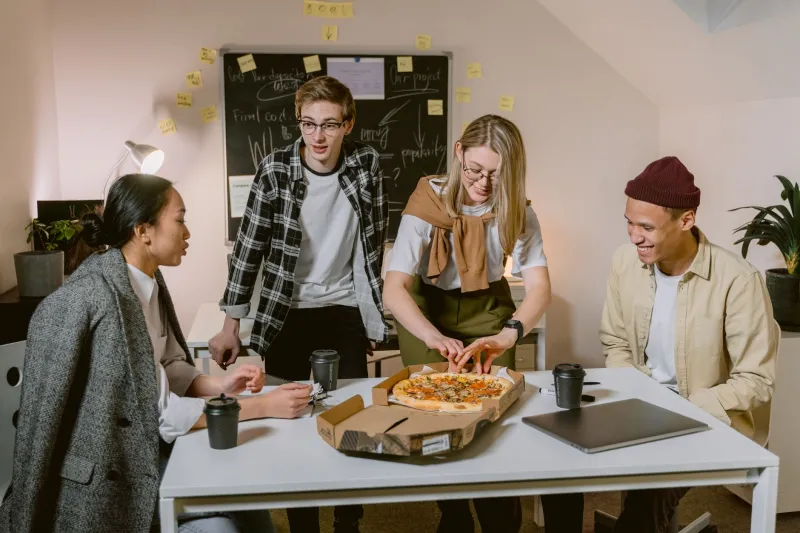
It starts innocuously enough. Someone pulls a small ziplock bag from their desk drawer. A coworker glances over. "What's that?" Three minutes later, half the open-plan office is huddled around a tin of sev, debating whether it tastes more like a pretzel or a noodle, and landing firmly on neither.
This scene — unremarkable on the surface — is playing out in tech campuses, law firms, hospital break rooms, and marketing agencies across the United States. And it's quietly reshaping how American workers think about snacking.
The Desk as a Tasting Counter
For many Indian professionals, sharing snacks isn't a calculated cultural gesture. It's just habit. Back home, snack time is communal by default. You don't eat your mixture alone at your desk — you pass it around. That instinct travels well.
"I don't even think about it," says Priya, a software engineer at a mid-sized tech firm in the Dallas area. "My mom sends a box every couple of months, and the moment it arrives, my coworkers already know. They've started asking when the next shipment is coming."
What she's describing is something food researchers might call a low-stakes taste gateway. There's no pressure, no performance. Someone offers, someone tries. Curiosity does the rest.
The snacks that tend to make the biggest first impressions aren't always the most complex. Roasted peanuts coated in a thin, spiced chickpea shell. Thin, crispy rice crackers with a hint of tamarind. Puffed lotus seeds dusted with chaat masala. These are approachable enough to not overwhelm a palate unfamiliar with Indian flavor profiles, but distinctive enough to make people ask questions.
The Potluck as a Cultural Portal
If the desk drawer is where individual conversions happen, the office potluck is where entire teams shift.
Diwali celebrations have become an unofficial entry point in workplaces with significant South Asian representation. Employees bring sweets and savories — besan ladoo, kaju katli, namkeen mixes — and suddenly the breakroom looks like a very well-stocked mithai shop. For many American coworkers, it's their first real encounter with Indian snack culture beyond a bag of chips from the international aisle.
But potluck moments aren't limited to festivals. There's the casual Friday someone brings a box of khakhra just because. The team lunch where someone contributes a container of homemade chivda. The birthday where instead of a grocery store cake, there's a tray of motichoor ladoo from the Indian grocery nearby.
Each of these moments chips away at the idea that Indian food is only for Indian restaurants or special occasions.
What Actually Sticks
Not every snack survives first contact. Certain flavors — intense asafoetida, very funky dried mango powder, deeply bitter fenugreek — can be a bridge too far for an uninitiated palate. Indian professionals who've done this long enough have an informal sense of what plays well.
Murukku, the spiral rice-flour crunch, almost always lands. So does mathri, the flaky, pepper-spiked cracker that feels like something a very sophisticated bakery might sell for $14 a bag. Roasted chana dal tends to convert the health-conscious crowd quickly once they realize it's basically a high-protein chip alternative.
"My coworker called mathri 'Indian shortbread' and honestly that's not wrong," laughs Anand, an accountant based in the Chicago suburbs. "Now he orders it online. He told me he brings it to his kids' soccer games."
That last detail matters more than it might seem.
The Ripple Goes Home
When a coworker tries something at the office and likes it, the story doesn't end at the parking lot. They go home and mention it at dinner. Their partner looks it up. Their teenager sees them ordering something unfamiliar from an Indian food website and gets curious. A new household starts keeping a snack or two on hand that wasn't there six months ago.
This is the micro-conversion effect in action — and it's driving measurable shifts in who's buying Indian snacks online. The customer base for specialty Indian snack retailers has been quietly diversifying, with a growing segment of non-South-Asian buyers who trace their first purchase back to "something a coworker had."
For Indian snack brands paying attention, this word-of-mouth channel is worth more than most paid advertising. Authentic peer recommendation, rooted in a genuine shared moment, carries a credibility no influencer post can fully replicate.
Beyond the Snack
There's something worth naming here that goes beyond market trends. When an Indian professional shares a piece of their food culture with a coworker, something small but real happens. Not a grand exchange of worldviews — just a moment of genuine curiosity, met with something delicious.
Food has always been the lowest-friction way humans let each other in. A tin of namkeen passed across a desk doesn't come with an explanation required or a cultural footnote attached. It just tastes good. Or it doesn't. But either way, someone tried.
In a country still figuring out how to have complicated conversations across cultural lines, the humble Indian office snack is doing quiet, unglamorous work — one crunchy handful at a time.
And if you happen to be on the receiving end of that tin? Take two. It's polite.